
Why Balance Changes With Age and What You Can Do About It

Maybe you reach for the railing more often than you used to. Uneven ground feels a little less comfortable. Standing on one leg to put on your pants seems harder. Or perhaps you simply don’t feel quite as steady on your feet as you once did. If any of that sounds familiar, you may be wondering: Why is my balance changing?
Balance can change as we get older, but age is only part of the story. Strength, vision, sensory changes, medications, health conditions, and activity levels can all affect how steady you feel. The good news is that there are practical things you can do to support your balance, mobility, and independence.
And you don’t have to wait for a fall to start.
Written by: Mary Bath, Doctor of Physical Therapy, Director of Balance Health, Kinis AI
Published in recognition of Falls Prevention Awareness Week, September 21–25, 2026—a nationwide effort to raise awareness that falls can be prevented and to help older adults remain active and independent.
Balance is a whole-body job
We tend to think of balance as something we either have or don’t have. In reality, staying upright requires several systems in your body to work together continuously.
Your brain receives information from your vision, your vestibular system in the inner ear, and your somatosensory system, which includes proprioception, your body’s ability to sense where your joints and limbs are in space. Your brain processes this information and coordinates responses through your muscles and joints to help keep you stable.
This happens constantly, whether you’re standing still, walking across a room, stepping off a curb, or recovering from a small misstep.
Why can balance change as we get older?
There isn’t one single reason.
Muscle mass and strength can decline with age, and changes in balance, gait, vision, hearing, and reflexes can all affect how we move. Certain health conditions can also contribute to balance problems. The National Institute on Aging notes that conditions affecting the heart, nerves, feet, blood vessels, vision, and other systems can influence balance and fall risk (National Institute on Aging).
Medications are another important consideration. Some prescription and over-the-counter medications can cause side effects such as dizziness, sleepiness, or confusion that may make someone less steady. That’s one reason medication review is commonly included in fall-prevention recommendations for older adults (CDC, 2026).
Changes can also build on one another. If you begin feeling less steady, you may become less confident about walking or exercising. But becoming less active can make it harder to maintain the strength and physical abilities you rely on for everyday movement. The National Institute on Aging specifically encourages older adults not to let fear of falling prevent them from staying active (National Institute on Aging).
The important point is that changes in balance shouldn’t automatically be dismissed as “just getting older.” There may be factors you can address.
Can you improve your balance as you get older?
Absolutely. Balance and strength can be trained in older adults.
A large Cochrane review examined 108 randomized trials involving more than 23,000 older adults. Exercise programs reduced the rate of falls by about 23% overall. Programs emphasizing balance and functional exercise were particularly effective, and programs combining different types of exercise, commonly balance and functional training with resistance exercise, also reduced falls (Sherrington et al., 2019).
Other research has similarly found that lower-body strengthening, balance exercise, and multicomponent exercise can improve measures of strength, balance, and mobility in community-dwelling older adults (Papalia et al., 2023).
That doesn’t mean everyone should follow the same exercise program. The right exercises and level of difficulty depend on your current abilities, health, and goals. But getting older doesn’t mean you have to stop challenging your balance or strength.
What can you do to support your balance?
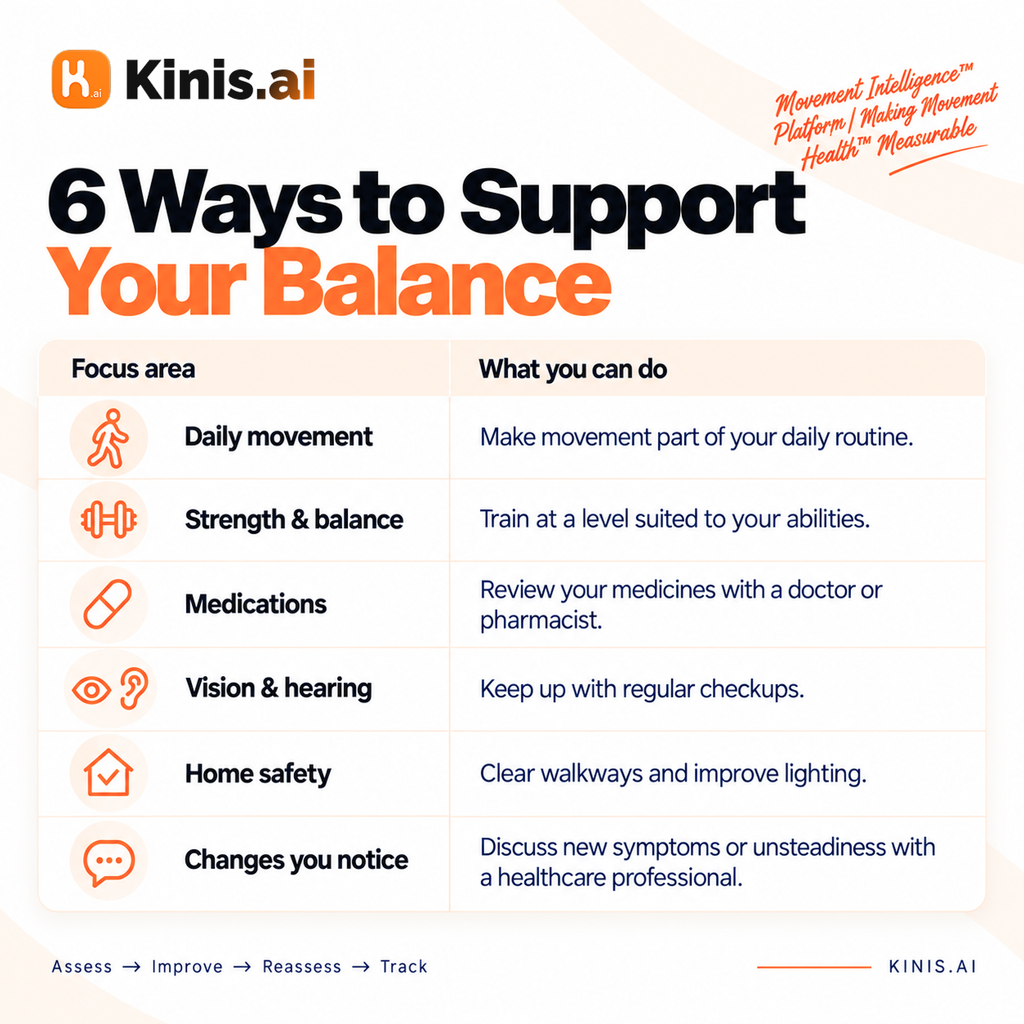
The good news is that there are practical steps you can take to support your balance and reduce your risk of falling. You don’t have to do everything at once. Start with the areas that are most relevant to you.
- Stay active. Regular physical activity helps maintain the strength and physical function you use every day. Try to make movement a regular part of your routine rather than something you only focus on when a problem appears (National Institute on Aging).
- Work on strength and balance. Exercises that strengthen your legs and appropriately challenge your balance are particularly important. Research supports balance and functional exercise as part of fall-prevention programs for older adults (Sherrington et al., 2019).
- Review your medications. Ask your doctor or pharmacist to periodically review your prescription and over-the-counter medications, particularly if you experience dizziness, drowsiness, or other side effects that could affect your balance (CDC, 2026).
- Keep up with vision and hearing care. Changes in vision and hearing can affect how you navigate your surroundings. Regular checkups can help identify changes that may need to be addressed (National Institute on Aging).
- Make your surroundings safer. Look for loose rugs, clutter, poor lighting, slippery surfaces, and other hazards around the home. Handrails and grab bars may also help in areas where extra support is useful (National Institute on Aging; CDC, 2026)
- Pay attention to changes. If you begin feeling less steady, have a fall, experience new dizziness, or notice a meaningful change in how you walk or move, don’t simply assume it’s part of getting older. Talk with a qualified healthcare professional (National Institute on Aging).
For caregivers and family members, you can help too. You may notice gradual changes in someone’s movement or confidence that they haven’t recognized themselves. Supporting safe activity, helping address hazards around the home, and encouraging appropriate medical follow-up can all be useful.
How do you know if your balance is changing?
Sometimes the first clues come from everyday life.Maybe getting up from a chair takes more effort. You use a railing on stairs when you didn’t before. You feel less confident on uneven ground. Or standing on one leg has become noticeably harder.
Those observations matter. But gradual changes can be difficult to judge based on memory and feeling alone.
This is where establishing a baseline can be useful.
A movement assessment gives you a starting point that you can return to later. For example, the Single Leg Stance test is a commonly used clinical assessment of static balance and postural control. Kinis uses the Single Leg Stance assessment along with other movement assessments to give you objective information about how you move.
The goal isn’t to tell you whether you’re going to fall. Instead, the idea is simple: assess where you are today, work on your movement, repeat the assessment, and see what has changed.
Having something measurable can make it easier to follow changes over time and provide useful information to discuss with a healthcare professional when appropriate.
Balance is only one part of fall prevention
Good balance matters, but falls are rarely about one thing.
Fall prevention can involve multiple factors, including strength and balance, medications, vision, health conditions, footwear, and hazards in the home (National Institute on Aging; CDC, 2026).
That’s why a balance assessment should not be treated as a fall-risk diagnosis. No balance score or single movement test can tell you with certainty whether you will or will not fall.
If you’ve recently fallen, feel increasingly unsteady, develop new dizziness or weakness, or notice a significant change in the way you walk or move, talk with a qualified healthcare professional. These changes deserve attention rather than simply being attributed to age.
Don’t wait for a fall to start paying attention to how you move
Most of us don’t wait until we have a serious dental problem to start taking care of our teeth. We brush them, pay attention to changes, and go for regular checkups because we know it’s better to take care of our dental health along the way than to wait until something goes wrong.
We can think about movement in a similar way.
You don’t need to wait until you’ve fallen to start paying attention to your balance, strength, and mobility. Stay active, work on your strength and balance, review your medications and vision, and make your surroundings safer (National Institute on Aging; CDC, 2026).
Most importantly, know your starting point. When you assess, improve, retest, and track over time, you can better understand how your movement is changing and take an active role in your Movement Health™.
Ready to learn more about how you move?
Start with a Kinis movement assessment and use code BALANCE for two free assessments.
Frequently Asked Questions
Is it normal for balance to get worse as you get older?
Balance often changes with age, but feeling less steady should not automatically be dismissed as “just getting older.” Changes in strength, vision, sensory function, medications, health conditions, and activity levels can all affect balance. Some of these factors can be addressed.
Can you improve your balance after age 65?
Yes. Balance and strength can be trained in older adults. Research has found that exercise, particularly programs that include balance and functional exercises, can improve physical function and help reduce falls in older adults (Sherrington et al., 2019; Papalia et al., 2023).
What exercises are best for improving balance?
There isn’t one exercise program that’s right for everyone. Exercises that appropriately challenge balance and strengthen the legs and core are commonly recommended for older adults. The right exercises and level of difficulty depend on your current abilities, health, and goals.
How often should you check your balance?
There isn’t one recommended testing schedule that applies to everyone. What matters is having a consistent way to establish a baseline and track meaningful changes over time. If you notice a significant change in your balance, walking, strength, or confidence, consider discussing it with a qualified healthcare professional.
Does poor balance mean I’m going to fall?
No. Balance is one factor related to falls, but falls are complex and can involve strength, medications, vision, health conditions, footwear, environmental hazards, and other factors. A balance assessment on its own cannot predict whether an individual will fall.
When should I talk to a healthcare professional about my balance?
Talk with a qualified healthcare professional if you’ve recently fallen, feel increasingly unsteady, experience new or unexplained dizziness or weakness, or notice a significant change in the way you walk or move. These changes are worth addressing rather than simply assuming they are part of aging.
References
Centers for Disease Control and Prevention. Preventing Falls and Hip Fractures. 2026.