
The Science Behind Standing on One Leg
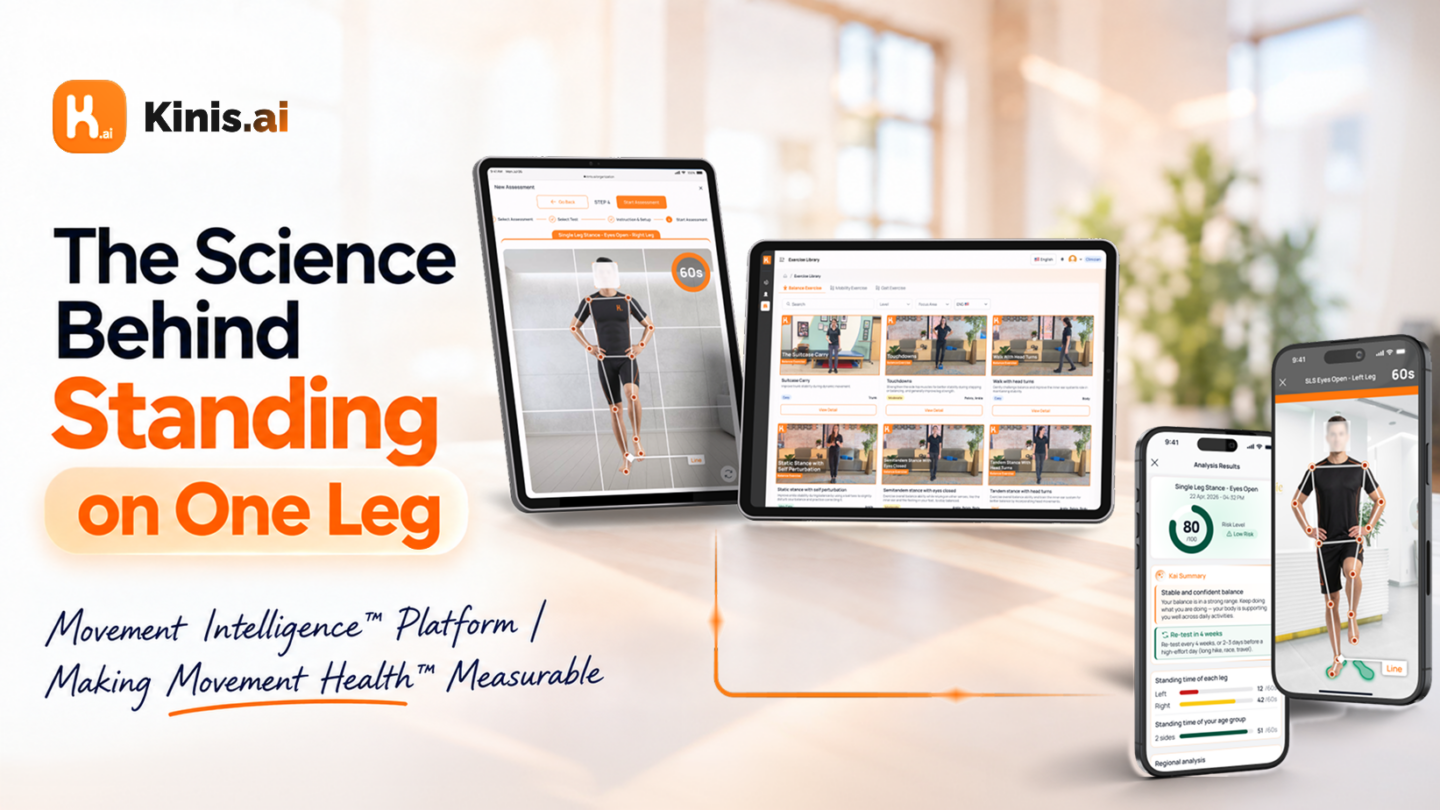
Standing on one leg may seem simple, but holding the position requires multiple systems in your body to work together to keep you upright, stable, and balanced.
The Single Leg Stance (SLS) test is a commonly used balance assessment that provides a simple way to measure this ability.
Kinis uses the SLS test as part of its approach to measuring Movement Health™. This article explains the test, what research tells us about it, how Kinis analyzes your performance, and what your results can and cannot tell you.
Written by: Mary Bath, Doctor of Physical Therapy, Director of Balance Health, Kinis AI
Balance 101: How your body keeps you upright
Maintaining balance during simple tasks like standing on one leg requires complex, continuous cooperation among multiple bodily systems.
To keep you upright, the brain continuously integrates sensory data from three distinct systems: your vision, which helps you understand where you are in relation to your surroundings; your vestibular system, located in your inner ear, which helps your brain keep track of the position and movement of your head; and your somatosensory system, which uses proprioception to sense where your joints and limbs are without having to look at them (Peterka, 2018).
Depending on the balance task and environment, the brain dynamically adjusts how much it relies on each sensory source. The nervous system then processes this integrated information to trigger precise responses, while the musculoskeletal system provides the physical strength and joint control necessary to make ongoing postural corrections (Peterka, 2018).
Interested in learning more about balance? Read the Vestibular Disorders Association’s The Human Balance System for more information.
What does the SLS test measure?
At its core, the SLS test assesses static balance and postural control. In the traditional clinical test, performance is typically measured by time: how long you can maintain the SLS before losing the required position.
Is there a normal SLS time?
There is no single “normal” time that applies to everyone. SLS performance changes with age, and results can also be affected by how the test is performed.
Testing protocols can vary in terms of footwear, arm position, whether the eyes are open or closed, which leg is tested, the number of trials, and the maximum test duration. Because these differences can affect performance, SLS results should be interpreted in the context of the specific protocol used.
Kinis uses a standardized protocol to help make results more consistent and comparable. The assessment is performed barefoot, with your hands on your hips and your raised leg held in a specified position. Following the same protocol is particularly important when comparing results over time.
Age also provides important context. In a study of 318 healthy adults, Vereeck and colleagues found that SLS performance decreased with age, supporting the use of age-specific reference values (Vereeck et al., 2008). A larger review of 23 studies involving more than 13,000 adults over age 60 similarly found that performance varied across age groups (Bohannon & Tudini, 2018).
This is why age-based norms can be helpful. They provide context for your result, allowing you to compare your SLS time with what is typical for people around your age. At Kinis, we compare your hold time against age-based norms.
How Kinis analyzes the SLS
Kinis brings the SLS assessment directly to your clinic or home using a smartphone or tablet. During the assessment, you follow the instructions in the Kinis app and perform the SLS while the device’s camera captures your movement. Kinis uses markerless visual skeleton tracking to analyze your performance.
The traditional SLS assessment primarily measures how long you can maintain the stance. But it can also be useful to understand how you maintain the stance. Research has used force platforms, motion sensors, and other methods to study how the body moves while maintaining balance. Studies have examined postural steadiness during one-leg stance, as well as movement at the ankle, pelvis, and trunk during balance and single-leg standing (Hertel et al., 2002; Jonsson et al., 2004; Prior et al., 2014).
Kinis builds on these concepts by looking at hold time along with four additional components of how your body moves while you balance:
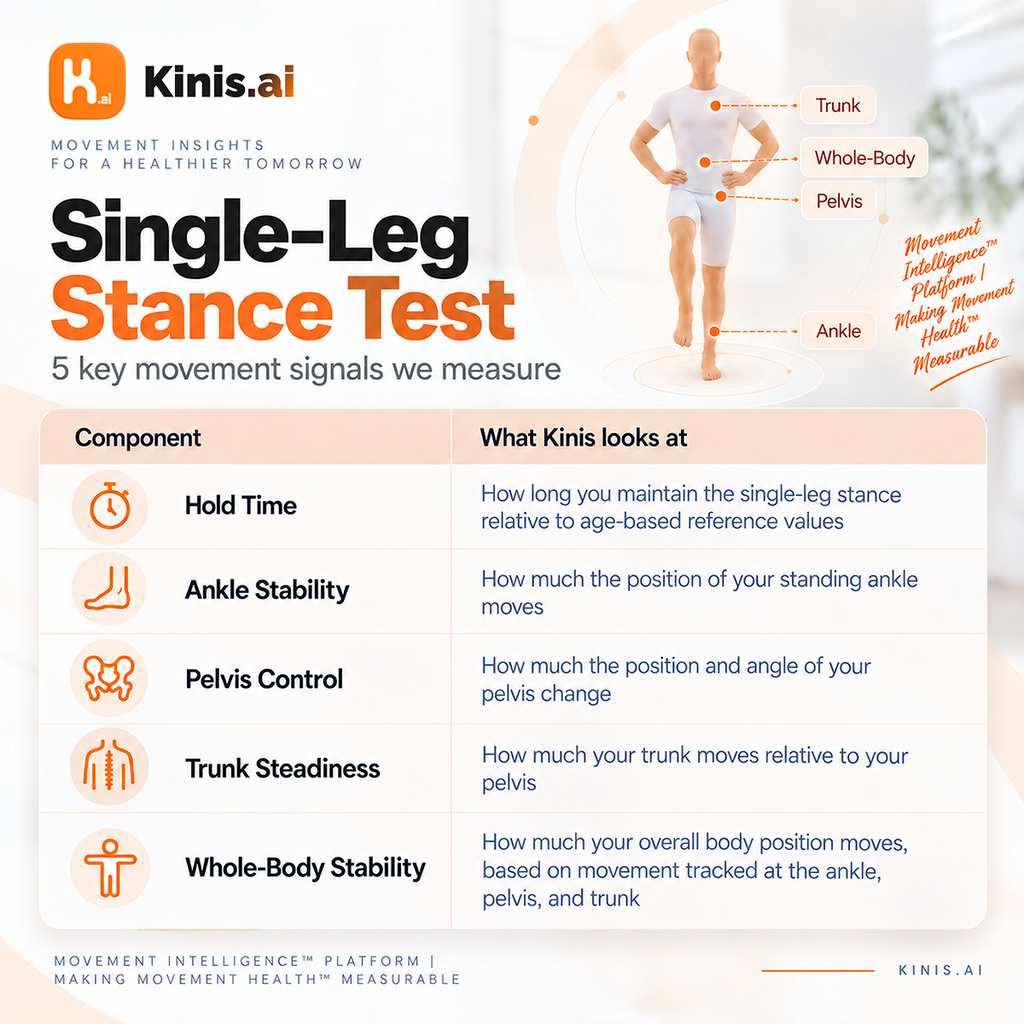
To calculate these components, Kinis tracks specific body landmarks throughout the test. For each component, Kinis calculates the average position across the entire trial and uses that average as the baseline. It then measures how much your movement deviates from that baseline from frame to frame.
For example, ankle stability looks at how much the standing ankle moves relative to its average position. Pelvis control uses tracked hip landmarks to measure changes in pelvic position and angle, while trunk steadiness uses shoulder and hip landmarks to measure movement of the trunk relative to the pelvis. Whole-body stability combines the tracked positions of the ankle, pelvis, and trunk to measure how much your overall body position moves relative to its average position during the trial.
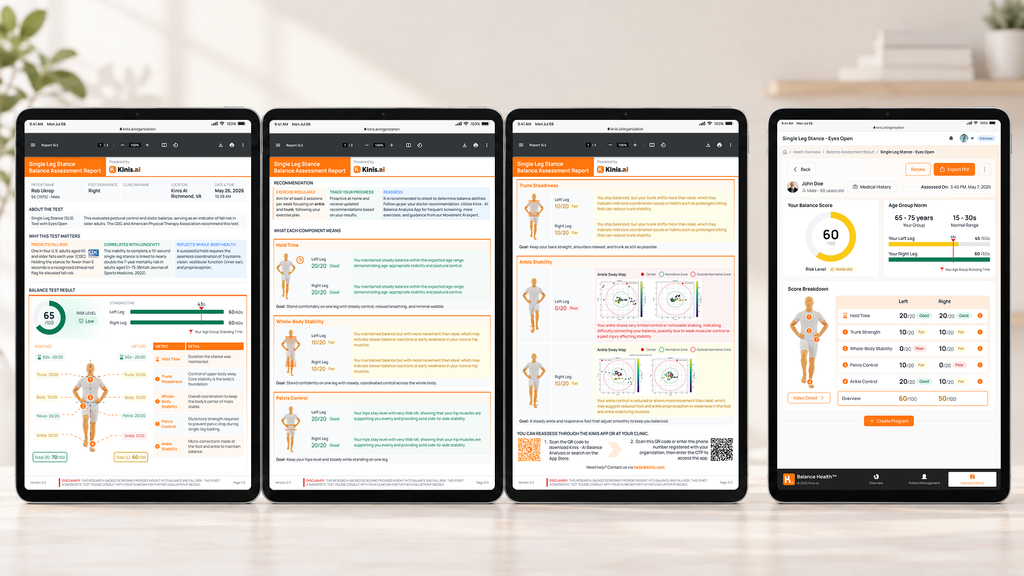
Kinis converts these measurements into individual component scores. Together, the five components contribute to an overall balance score, providing information about both how long you balance and how you maintain that balance. Results are reported separately for each leg.
The SLS is an established balance assessment, and published research supports studying features such as postural steadiness and movement during single-leg standing. The specific landmarks, calculations, thresholds, component scores, and overall scoring method used by Kinis are Kinis-developed methods informed by research. They should not be interpreted as a diagnosis or as a replacement for a standardized clinical evaluation.
Understanding your Kinis results
Your Kinis results give you a measurable starting point for understanding and tracking your balance. The assessment produces results for the left and right legs, including the individual movement components and an overall score. Kinis also uses assessment results to help guide personalized exercise programs.
The goal is to use your results as a baseline to track change over time. Your first assessment shows where you are starting. You then receive an exercise program to work toward improving your balance and repeat the assessment to see what has changed.
This is particularly useful because balance may not change in just one way. Your hold time could improve, for example, while changes in trunk, pelvis, or ankle movement may provide additional information about how you are performing the test.
Your results are most useful when interpreted alongside how you feel and function, your goals, any symptoms you may be experiencing, and, when appropriate, guidance from a qualified healthcare professional.
What can the SLS test tell you?
The SLS test provides useful information about your balance performance. Along with your Kinis results, it can help you:
- Understand your current balance performance
- Compare your hold time with age-based reference values
- Look at how you maintain the position, including movement at the ankle, pelvis, and trunk
- Establish a baseline for future comparison
- Track changes when you repeat the assessment over time
What can’t the SLS test tell you?
The SLS test does not provide a complete picture of your health or mobility. It also cannot, on its own:
- Diagnose a health condition
- Assess or diagnose an injury
- Predict whether you will fall
- Capture every aspect of balance you use in everyday life
- Replace an evaluation by a qualified healthcare professional
A systematic review examining SLS and other commonly used clinical balance tests found that these tests had limited accuracy for predicting future falls when used alone (Omaña et al., 2021). Falls are complex and can be influenced by many factors beyond standing balance.
SLS performance can also be influenced by age, fatigue, pain, attention, health conditions, and the testing environment. And the test measures balance under one particular condition. Everyday balance may involve walking, turning, changing surfaces, avoiding obstacles, multitasking, and reacting to unexpected movement.
Overall, the SLS is best used as one piece of information about your balance performance. When performed consistently and repeated over time, it can provide a useful way to establish a baseline and track change, but the results should always be considered in the broader context of how you feel, move, and function.
Safety: Who should not perform the test?
Do not perform the SLS assessment if:
- You need a cane, walker, or another assistive device to stand safely
- You need another person’s assistance to stand
- You have had a recent fall
- You have unexplained dizziness or vertigo that has not been evaluated
- You have an acute injury or severe pain
- You have post-surgical restrictions
- A healthcare professional has told you not to exercise
- You do not feel safe attempting the test
If you are unsure whether the assessment is appropriate for you, speak with a qualified healthcare professional first.
If you do perform the test, use a safe environment away from stairs or obstacles and keep a stable support surface nearby. Stop immediately if you feel pain, dizziness, light-headedness, or unsafe.
Frequently asked questions
What is the single leg stance test?
The single leg stance test is a balance assessment in which you stand on one leg for as long as you can maintain the required position.
What does the single leg stance test measure?
It measures static balance and postural control. Depending on the method used, it may also describe movement of the ankle, pelvis, trunk, and whole body.
Is there a normal time for standing on one leg?
There is no single normal time that applies to everyone. Single leg stance time varies with age and can also be influenced by testing conditions and the specific test protocol used.
Can the single-leg stance test predict falls?
No. The test can provide information about balance performance, but it should not be used alone to predict whether an individual will fall.
How does Kinis analyze the test?
Kinis uses markerless visual skeleton tracking through a smartphone or tablet camera to analyze hold time and selected movement patterns around the ankle, pelvis, trunk, and whole body.
Can my results diagnose a condition?
No. Kinis assessment results are not intended to diagnose a condition, assess an injury, or replace evaluation by a qualified healthcare professional.
References
- Bohannon RW, Tudini F. Unipedal balance test for older adults: a systematic review and meta-analysis of studies providing normative data. Physiotherapy. 2018;104(4):376–382.
- Hertel J, Gay MR, Denegar CR. Differences in postural control during single leg stance among healthy individuals with different foot types. Journal of Athletic Training. 2002;37(2):129–132.
- Jonsson E, Seiger A, Hirschfeld H. One-leg stance in healthy young and elderly adults: a measure of postural steadiness? Clinical Biomechanics. 2004;19(7):688–694.
- Omaña H, Bezaire K, Brady K, et al. Functional Reach Test, Single-Leg Stance Test, and Tinetti Performance-Oriented Mobility Assessment for the prediction of falls in older adults: a systematic review. Physical Therapy. 2021;101(10).
- Peterka RJ. Sensory integration for human balance control. Handbook of Clinical Neurology. 2018;159:27–42.
- Prior S, Mitchell T, Whiteley R, et al. The influence of changes in trunk and pelvic posture during single leg standing on hip and thigh muscle activation in a pain-free population. BMC Sports Science, Medicine and Rehabilitation. 2014;6:13.
- Vereeck L, Wuyts F, Truijen S, Van de Heyning P. Clinical assessment of balance: normative data, and gender and age effects. International Journal of Audiology. 2008;47(2):67–75.